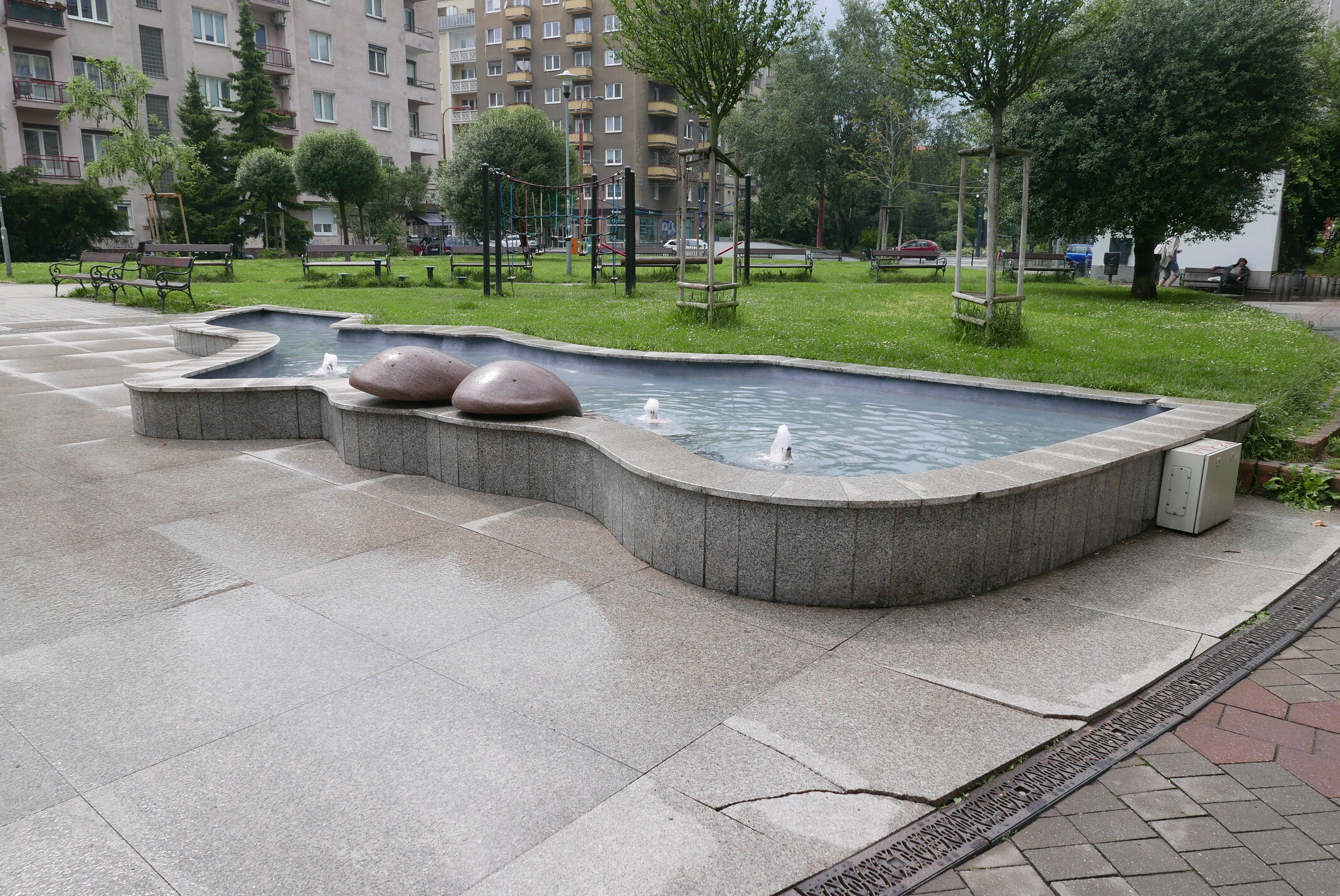
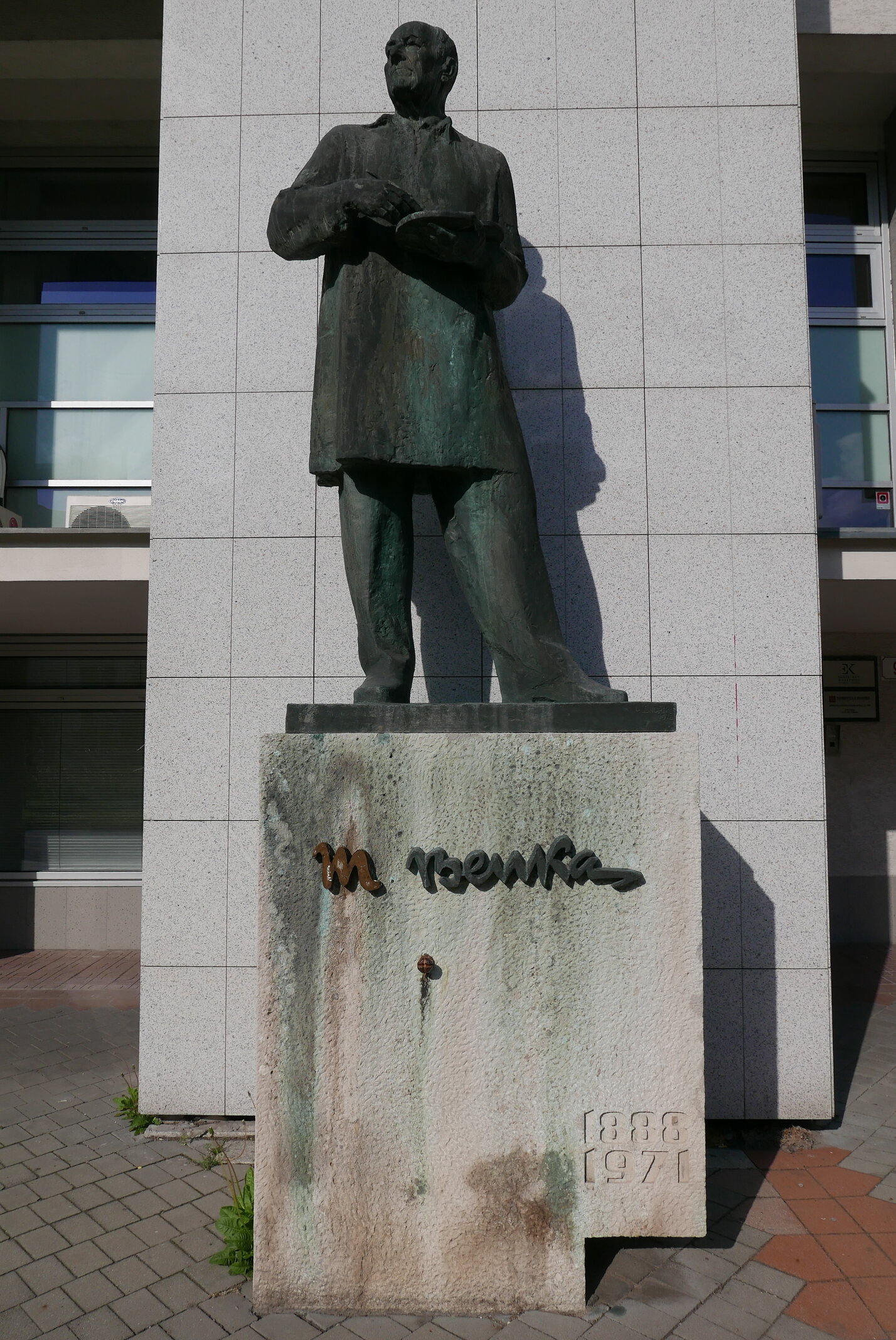
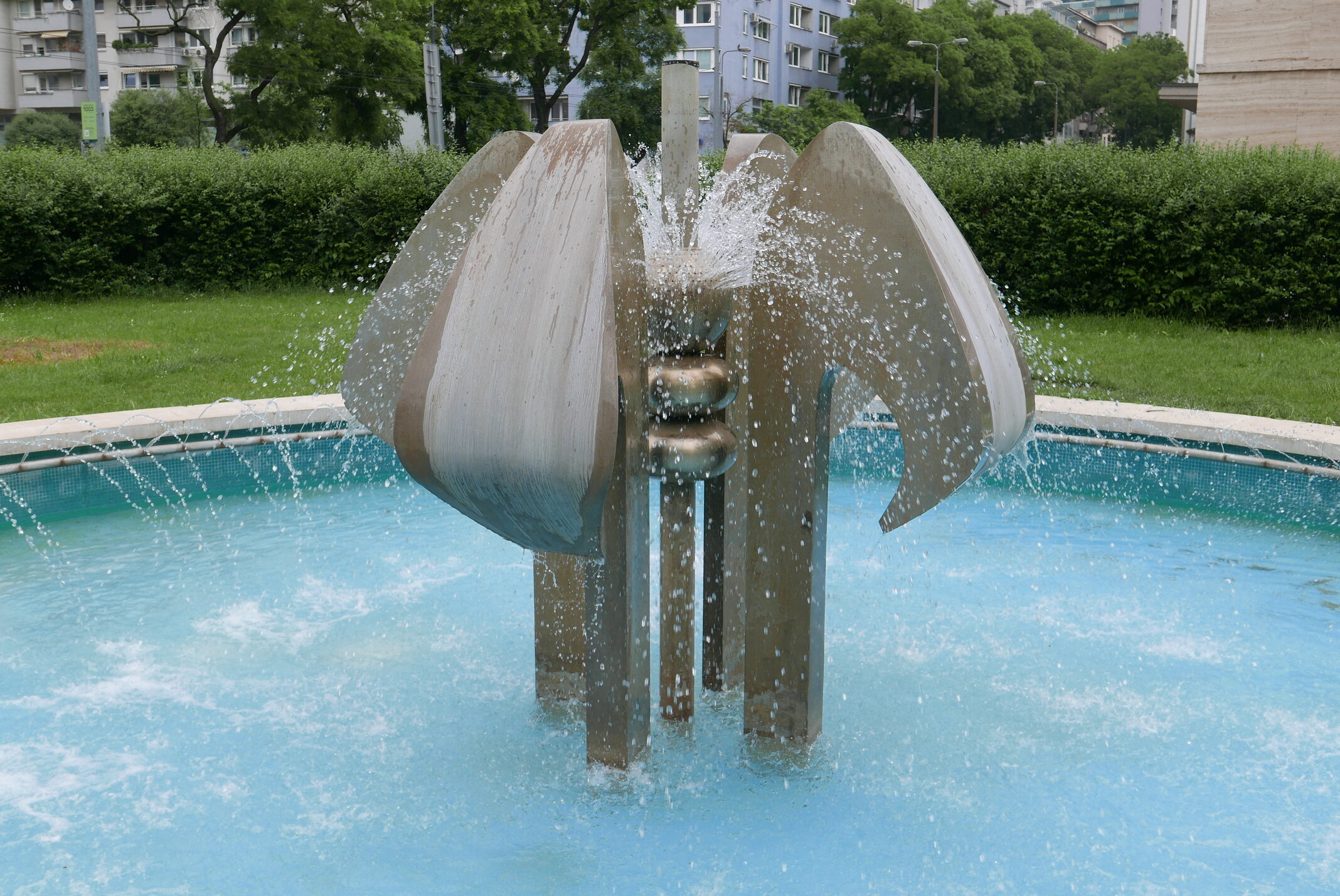
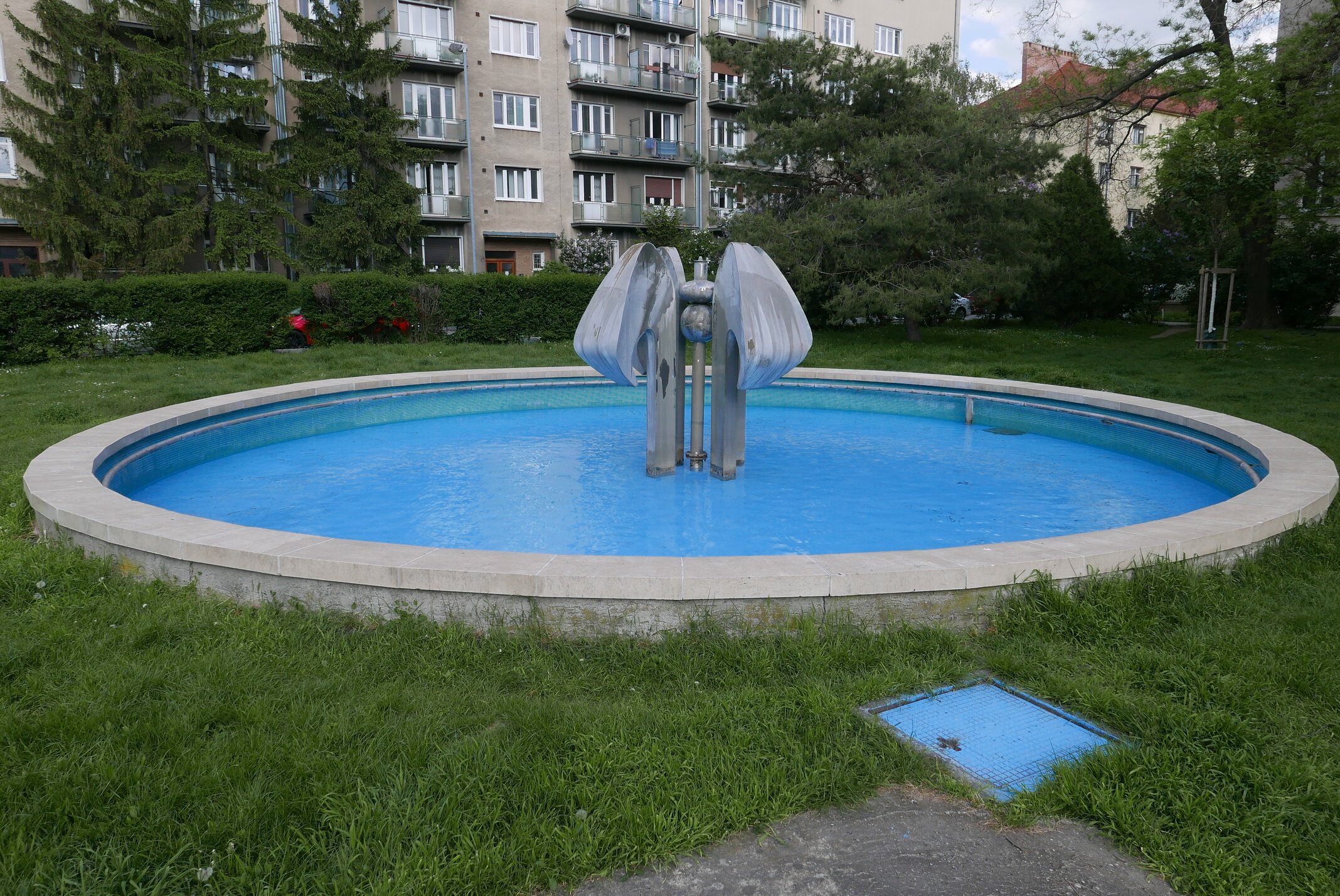
Martin Benka Square was created on the vacant land left following the demolition of older buildings between Záhradnícka and Krížna streets. In 1978, a statue of the painter Martin Benka was erected at the centre of the square (it has since been moved by a few metres). However, the space did not feel like a square; rather, it resembled a vacant lot with an unkempt lawn. It was not until the late 1990s that a multipurpose building, designed by the architect O. Peržel, was completed, thereby filling the gap in the residential complex between Krížna and Záhradnícka streets. The project included the design for a new public space and creation of a square with paved areas, landscaping, water features, and seating. In 1999, art-architectural elements were added to the square to stand alongside the older statue of M. Benka – an asymmetrical fountain by R. Baláž and M. Maličevič, and Millennium, a tall glass structure with clocks, by V. Oravec and M. Pagáč.
Millennium comprises four tall pillars connected at the top by intersecting prismatic beams. The metal-framed structure is entirely clad in mirrored glass panels precisely cut into trapezoidal and triangular shapes. The faceted surface of the artwork reflects its surroundings from various angles, creating unexpected perspectives and optical illusions. Its appearance alters throughout the day with the changing intensity and angle of incoming light. In the evening, the ambiance is enhanced by coloured lighting embedded into the platform, and by the lights reflected from the surrounding area. At the top of the structure, minimalist circular clocks made of frosted white glass are mounted on all four sides, contrasting with the glossy mirrored cladding of the pillars. The hour hands are formed by simple black metal strips.
The Millennium sculpture is one of the most successful works of art from the post-Velvet Revolution era within Bratislava’s public spaces. It was the result of a collaboration between glass artists and an architect, and was part of a comprehensive design for the square that included the multipurpose building. The design is minimalist and elegant. Through varying reflections of its surroundings, it produces an element of surprise and playfulness, bringing to the space a sense of dynamism. The high-mounted clocks are both practical and aesthetic. They represent a modern interpretation of city clocks typically found on poles and building façades, objects that have served — and continue to serve — as popular landmarks and meeting places. It is therefore all the more sad that Millennium is often targeted by vandals; due to its fragile surface, it is particularly vulnerable and requires extensive maintenance.
ZD
Research status as of 30. 04. 2024.